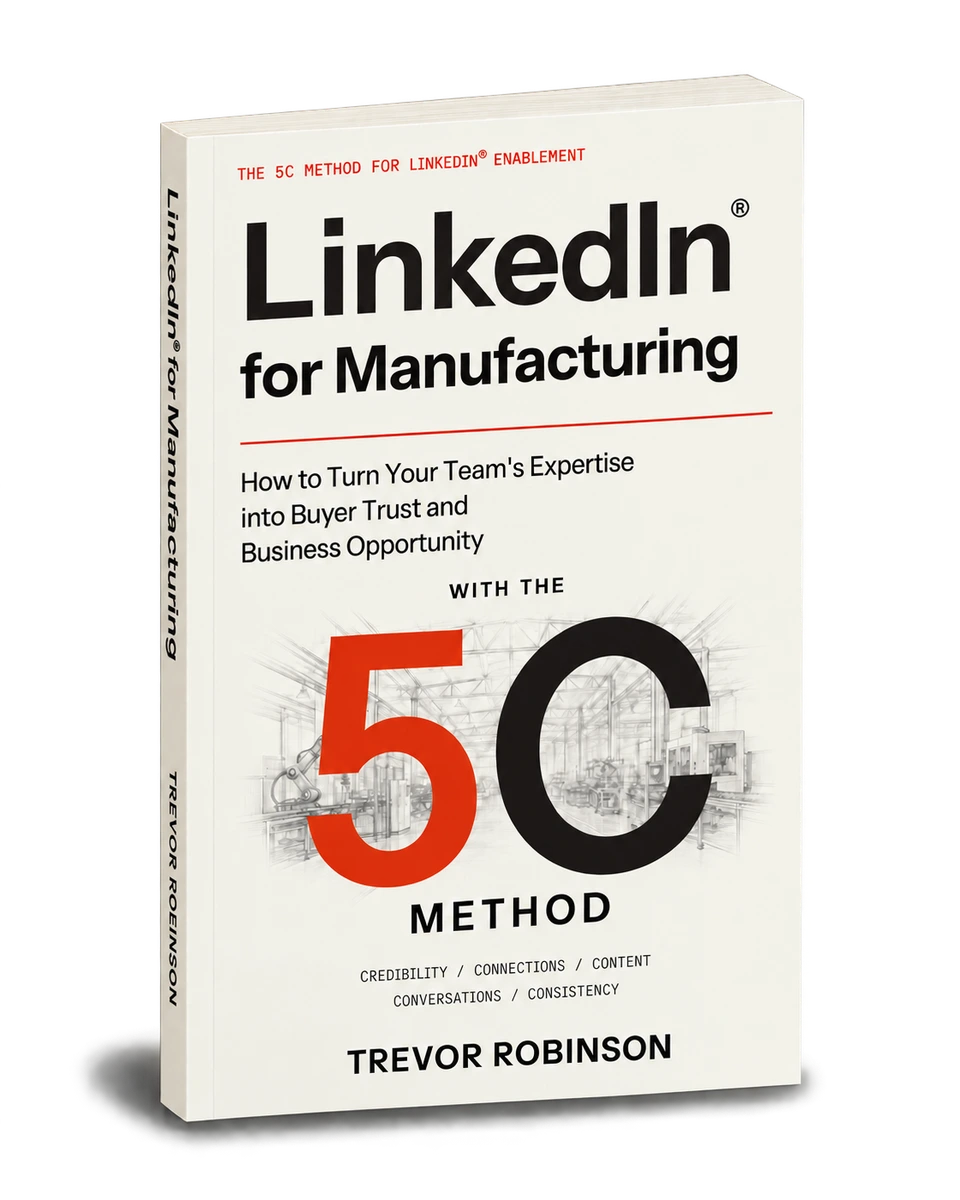

Employee advocacy · LinkedIn for Manufacturing field guide

How to Build a LinkedIn Employee Advocacy Program for Manufacturing Teams

A practical system for turning the expertise inside your manufacturing company into trusted visibility without scripts, spam, or a content treadmill.

By 7 min read
The advocacy operating system: Executive sponsor, Skilled employees, Useful ideas, Weekly rhythm, Business signals
The 5C Manufacturing LinkedIn Growth System field guide by LinkedIn for Manufacturing: the advocacy operating system.

A LinkedIn employee advocacy program should make your company easier to trust through the people who know the work. Employees contribute expertise and perspective in their own voices. The program gives them five practical capabilities: credible profiles, relevant networks, useful content, meaningful conversations, and a repeatable routine.

Key takeaways
  • Start with a business problem and a defined audience. A posting quota cannot replace either one.
  • Train a committed pilot group before inviting the whole company.
  • Give employees prompts, examples, and guardrails while preserving their voice.
  • Measure activation and audience quality before attributing pipeline.

What employee advocacy means in practice

Employee advocacy is the intentional practice of helping employees share expertise, perspective, and company-relevant ideas through their own professional networks. It works because buyers evaluate people as well as brands. But reach is a by-product, not the operating goal.

Employee advocacy and social selling support different parts of the same growth system. See the employee advocacy vs social selling guide for manufacturers to define each motion clearly.

A weak program starts with content distribution: marketing writes, employees copy, and everyone counts impressions. A strong program starts with audience value: employees learn what their buyers care about, how their role gives them a useful point of view, and how to turn real work into relevant content and conversations.

Weak programStrong programWhy it matters
“Please share this”Prompts and expert contextOriginal perspective earns more trust than repetition.
Everyone on day oneSmall cross-functional pilotA pilot can create examples, evidence, and potential internal champions.
Impressions onlyActivation, audience, conversations, outcomesThe measurement follows the buyer journey.

Set the program strategy before choosing tools

Write a one-page charter. Name the commercial or talent outcome, the audience, the employee groups involved, and the behavior the program is meant to create. “Increase visibility” is too vague. “Help 20 subject-matter experts become recognizable to operations leaders in our target accounts” is usable.

Then establish the baseline: active participants, profile quality, network relevance, posting frequency, audience demographics, meaningful comments, direct conversations, and attributable opportunities. An undated LinkedIn employee-advocacy analytics guide offers a useful historical measurement framework. LinkedIn began discontinuing its My Company and Employee Advocacy tabs in November 2024, so do not treat that guide as documentation of current program-level dashboard features. Use current member and Page analytics, consent-aware internal snapshots, conversation records, and CRM evidence instead. See LinkedIn’s discontinuation notice.

  • One primary audience
  • One business outcome
  • A 90-day pilot
  • Named executive sponsor
  • Participant baseline
  • Monthly review owner

Build a self-managed 90-day advocacy pilot in four phases

Weeks 1-2: diagnose and recruit

Select 10-25 volunteers across leadership, sales, marketing, customer success, and technical roles. Prioritize proximity to customers and willingness to practice over follower count. Review profiles, network composition, content comfort, and time constraints.

Weeks 3-4: install the core skills

Train the five connected behaviors: credibility, connections, content, conversations, and consistency. Employees need a complete path from being discovered to starting a relevant business conversation. Posting without profile or network work produces shallow reach; networking without useful content produces cold outreach.

Weeks 5-8: practice with support

Use office hours, peer review, examples, and short assignments. A content prompt should help someone retrieve an idea from their own work: a customer question, a tradeoff, a mistake, a pattern, or a lesson. It should never prescribe their opinion.

Weeks 9-12: codify what worked

Review participation, audience quality, conversation evidence, and friction. Convert successful prompts and workflows into the company playbook, then decide whether to expand. If your team wants guided training and reinforcement instead of running this self-managed plan alone, the 45-day 5C Manufacturing LinkedIn Team Sprint provides a defined cohort and support period.

Create guardrails teams can remember

A useful policy protects the employee and company without making ordinary participation feel dangerous. Cover confidentiality, customer permission, material nonpublic information, regulated claims, respectful conduct, disclosure, intellectual property, and escalation. Use plain-language examples for “safe,” “ask first,” and “do not share.”

Separate governance from voice. Legal and communications teams should define risk boundaries; they should not flatten every employee into one approved tone. Employees need the confidence to say, “Here is what I have learned,” while understanding where expert opinion ends and official company representation begins. See our detailed employee advocacy policy guide.

Measure adoption before declaring ROI

Use a measurement ladder. First ask whether people activated: profile updates, relevant connections, posts, comments, and routine adherence. Then ask whether the right audience responded: buyer-role demographics, saves, substantive comments, profile views, inbound connections, and direct replies. Finally connect those signals to outcomes: meetings influenced, opportunities touched, recruiting conversations, partner introductions, or reduced paid-content dependence.

Do not force precise revenue attribution where the data cannot support it. Record evidence consistently instead: CRM source notes, campaign links where appropriate, “how did you hear about us?” responses, and a lightweight conversation log. Our employee advocacy ROI guide provides the complete scorecard.

The 90-day advocacy pilot: Diagnose, Audience, baseline, friction; Install, Profiles, networks, skills; Reinforce, Practice, coaching, examples; Decide, Evidence, changes, expansion
A controlled build from baseline to expansion.

Decide what the pilot must prove

A pilot exists to reduce uncertainty. Before recruiting participants, write the three questions the pilot must answer. A useful set is: Can employees produce credible ideas from their work? Can the organization support them without taking over their voice? Do the resulting interactions reach people who matter to the business?

Define the intended audience by role, industry, company type, and business situation. Then choose one outcome the team can observe inside 90 days, such as more conversations with operations leaders in target accounts. Revenue can remain a long-term goal, but a short pilot should be judged on the evidence it can reasonably create.

Pilot charter

Write one sentence for the audience, one for the business problem, one for the employee behavior, and one for the evidence required to expand. If the charter needs a page of explanation, the program is still too broad.

Give every function a defined job

Advocacy fails when ownership is vague. The executive sponsor protects time and explains why the work matters. Marketing supplies research, editorial support, and brand context. Legal defines practical boundaries. Managers reinforce the routine. Participants contribute expertise and decide what they are comfortable publishing.

RoleWeekly responsibilityDecision right
Program leadPrompts, office hours, reportingCadence and support
ManagerConnect activity to live workTime and priorities
EmployeeDevelop ideas and participatePersonal voice and publication
Legal or complianceClarify risk with examplesRestricted claims and disclosures

This division protects authenticity while giving the program enough structure to operate. It also prevents marketing from becoming a bottleneck for every post.

Use a real pilot scenario

Consider a manufacturer introducing a predictive-maintenance service. The pilot audience is plant operations leaders. Ten employees join: two executives, three sellers, three subject-matter experts, and two customer leaders. Subject-matter experts explain failure patterns and implementation tradeoffs. Executives discuss capital planning. Sellers connect those ideas to account conversations. Customer leaders surface adoption lessons.

The program lead records which posts reach operations roles, which comments contain substantive questions, and which interactions create a next conversation. After 90 days, the team can see whether expertise travels across the buying group and which roles need more support. This is more informative than asking whether the company accumulated a large impression total.

Read the measurement ladder correctly

An undated LinkedIn Employee Advocacy Analytics Guide described adoption, education, recommendation, and audience measures for a product experience LinkedIn began discontinuing in November 2024. Treat those categories as historical context, not available program-level dashboard features. The four-level scorecard used here is the 5C operating framework: participation, audience quality, conversation evidence, and commercial influence. Use current member and Page analytics with consent-aware internal records.

Set a baseline before training. Review the same measures every four weeks. Record influenced opportunities only when a seller or participant can describe the connection between a LinkedIn interaction and the account activity. This discipline keeps the report credible and makes weak links in the program visible.

Use the pilot review agenda

Run the review at days 30, 60, and 90. Begin with the charter: audience, business problem, employee behavior, and evidence required. Then review activation across the team, examples of audience quality, three substantive interactions, and the strongest business signal. Ask participants where the work created value and where it competed with their job.

End with four decisions: what to keep, what to change, what to stop, and whether to expand. Assign an owner and date to each change. A program should not add participants until the current cohort has a stable workflow, clear policy support, and a manager cadence that does not depend on the program lead chasing people.

  • Charter still accurate
  • Activation across the team
  • Relevant audience evidence
  • Conversation examples
  • Friction by cohort
  • Named next decisions

How to start employee advocacy in a manufacturing company

Begin with a business priority and a willing cohort. Include the people who can explain the work: sellers, application specialists, engineers, product managers, and leaders. Give marketing a support role and name a sponsor who can protect time for participation.

Illustrative workflow: turn an application question into buyer education

  1. Capture: an application specialist records a recurring buyer question, without customer names or confidential specifications.
  2. Clarify: marketing helps turn the answer into a short explanation of a tradeoff, preserving the expert’s judgment.
  3. Review: the designated reviewer checks technical claims and permissions before publication.
  4. Contribute: the expert publishes or comments in their own voice, while sellers use the explanation when it is relevant to a conversation.
  5. Learn: the team reviews the buyer roles reached, substantive questions, and appropriate follow-ups.

This is a proposed operating example, not a reported customer outcome. The company supplies time, editing help, and a review path. Participation should respect employees’ control of their personal profiles.

Connect the workflow to the employee advocacy policy guide and the LinkedIn analytics guide for B2B teams. Record a baseline before attributing changes to the program.

Frequently asked questions

How many employees should an advocacy pilot include?

For most manufacturing organizations, a group of 10 to 25 committed volunteers is enough to test the system across roles without creating an unmanageable coaching burden.

Do employees need prewritten posts?

No. Provide prompts, examples, source material, and optional structures. Requiring copied posts suppresses expertise and makes participation feel inauthentic.

How long before an employee advocacy program shows results?

Activation signals can appear early. Audience quality and conversation signals may require a longer observation window, depending on participation cadence and the company’s sales cycle. Track commercial outcomes as influence, not instant attribution.

Research and method: This guide separates documented platform features and cited research from the operating recommendations used in the 5C Manufacturing LinkedIn Growth System. LinkedIn analytics are estimates, research findings describe their stated samples, and platform features can change. Review the linked primary sources before implementing account-specific workflows.

Bring the 5C system to your team

Turn this LinkedIn challenge into a repeatable team capability.

LinkedIn for Manufacturing trains your team to apply the 5C system to its real buyers, products, expertise, and sales cycle.

Compare training programs